 Choose Language
Choose Language
Choose Language
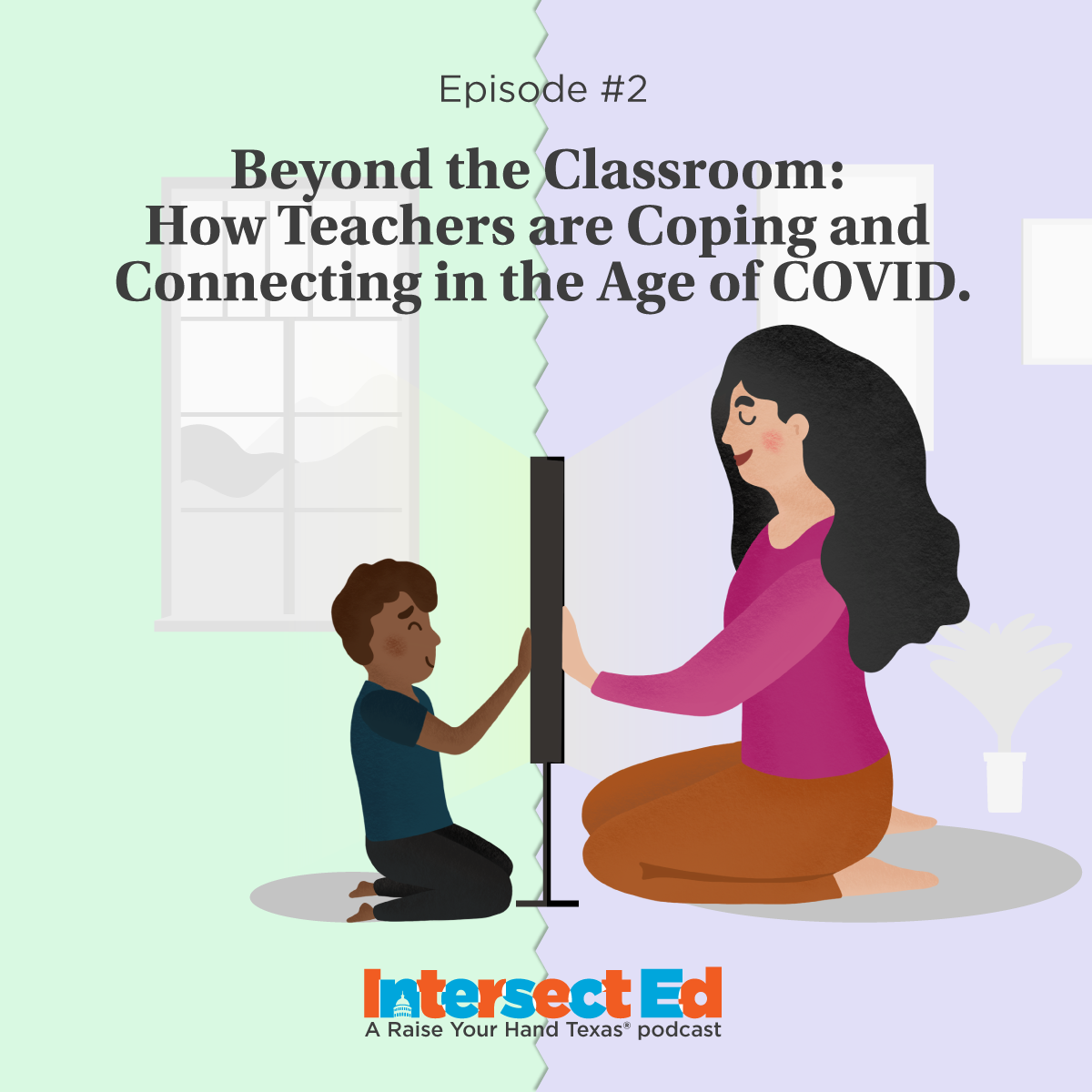
We recently released a new podcast series, Intersect Ed, where the stories of Texas public education policy and practice meet.
In our second episode, we are digging even deeper into teachers’ work during the COVID-19 pandemic this past spring. We learned that what educators experienced during remote learning highlights the inequities of virtual school.
Hear from five Texas teachers about the barriers they faced and the ways they overcame them to find connections with their students. And if you haven’t already, make sure to subscribe!
Note: Intersect Ed is best experienced as a podcast. If you are able, we encourage you to listen to the audio, which includes emotion and emphasis missing from the transcript.
Tessa Benavides: From Raise Your Hand Texas I’m Tessa Benavides. and you’re listening to IntersectEd, where the stories of Texas public education policy and practice meet.
In the first episodes of Intersect Ed, we are telling the stories of Texas public school teachers rising to the challenge of COVID-19 – how it has affected them mentally, in their daily work, and in their relationships with each other and their students.
When Texas schools closed in mid-March, teachers had to pivot almost overnight to a new model of teaching, while simultaneously dealing with crisis management. We wanted to dig deeper and better understand what an average day looked like for teachers during what was a tumultuous spring semester.
In this episode, we talk to five diverse teachers from across Texas. As we learned about their day-to-day interactions with students and families, we also learned about the barriers they had to navigate through to reach, connect with, and instruct their students. What we learned is that what educators across Texas experienced during remote learning through the spring semester highlights the inequities of virtual school.
Tessa: We heard how a lack of access to reliable internet and technology impacts students.
Megan Fadal: Definitely, with the zoom calls, the volume goes in and out, or it will shut off, and then, come back on. That’s been a struggle sometimes, but we always figure it out together.
Tessa: What the challenges of building an engaging virtual classroom are.
Michelle Sandoval: Even through a computer screen, I’m blasting music. I’m as funny as ever, as charismatic as ever, and that doesn’t change.
Tessa: How housing insecurities limit student engagement.
Shawn Sheehan: I did find out one of my students and his father had moved, and I don’t know where they are, nor would I expect them to just openly say, “Hey, we are here in such and such place, living with so and so.” And yet we’re still asking this kid to do an hour worth of English work, an hour worth of math, some science work, and whatever elective he’s taking.
Tessa: What happened to students as the economic impacts of the pandemic hit Texas families.
Kynan Murtagh: Most of my students are still working. I’ve made efforts to go to specific Whataburgers or whatever to find them.
Tessa: And finding ways to meaningfully connect with parents.
Chantal Smith: I don’t expect the parent to set out science experiments, and have long lessons or anything like that, but there are different little things that the parent wouldn’t think to do that they can incorporate each day.
Tessa: Despite the increased hours and challenges they faced in managing a crisis, what we learned as we spoke to teachers is that they did everything they could to remain resilient and steadfast for their students.
In Lindale ISD, a small district near the piney woods of East Texas, first-grade teacher Megan Fadal remained upbeat while finding ways to engage her students in meaningful learning experiences despite missing her classroom – even when she, herself, experienced the challenge of internet connectivity.
Tessa: As you’re trying to stay connected with your students have you faced any technology barriers, either personally, or that your students have faced, that have affected your day-to-day interactions with them?
[silence]
Tessa: Oh, Megan, we can’t hear you.
[silence]
Tessa: Oh No. Wait, there you are.
Megan: You can hear me now?
Tessa: Yes.
Megan: There you go. Perfect example
Megan: My kids too, I’m like, “Ugh.”
Tessa: Oh, we lost you again.
Tessa: For Megan, the barriers she faced using technology to engage with her students goes beyond the audio dropping during a Zoom call. For her, remote teaching is missing aspects that only the in-classroom experience can provide.
Megan: In my classroom, I do a lot of hands-on manipulatives, so just being there in the moment and being there with the kids and doing something completely different. I’m not really a worksheet teacher. I love to get hands-on and all that.
Tessa: Megan has spent extra time designing engaging and innovative approaches to teaching virtually.
Megan: We did a virtual field trip last week. On Wednesday we went to the San Diego zoo, and you can pull up the live cams. And so we got to visit some of the animals that my students had actually researched and just share some interesting facts about them, their diet, and their habitat. So it was a good conclusion to our animal research unit.
Tessa: This example is just one of so many that we heard from teachers of ways that they strived to make their virtual classrooms feel like their in-person classrooms.
Michelle Sandoval, an eighth-grade math teacher at Parkland Pre-Engineering Middle School in Ysleta ISD, echoes this sentiment. She wanted to create a feeling of normalcy for her students by bringing some of her in-person traditions online.
Michelle: I’m that one teacher that has the music blasting in her classroom during transition, and you know you’re walking into my room because I’m dancing and laughing, but that hasn’t changed.
Tessa: Michelle was born and raised in Northeast El Paso and teaches at the same middle school she attended growing up. Returning to Ysleta ISD fulfilled a personal promise she made to her community. In October, Michelle was named the 2020 Texas Secondary Teacher of the Year by the Texas Association of School Administrators.
As her schedule for remote learning found a rhythm, Michelle found that her relationships with her students and their families was a key factor in how they moved forward together through the semester.
Michelle: I had a social hour every Thursday, The most I had was 71. That’s a lot. It’s a big Zoom party. It’s just a fun time, and that’s something that I found that the kids enjoy, and it actually keeps them engaged into school. I want to stay connected with their families, with their parents and over here in our neighborhood sometimes we have abuelas and abuelos, grandparents, tias, tios, big brothers, big sisters, whoever it is that is the guardian, whoever is taking care of them. I like to do scavenger hunts, different things. I’m like, “Okay, go get your mom,” and we play with the parents and we do fun things to get them involved because I think it is so important that the parents are still connected in the whole aspect.
Tessa: Connectivity has been an important issue for teachers and educators as they managed remote learning through the COVID-19 pandemic. In Lewisville, Texas, a suburb within the Dallas-Fort Worth Metroplex, Shawn Sheehan, an Alegra I English as a second language teacher, shared about the different challenges he has faced staying connected with students including what happens when his students faced housing insecurities.
Shawn: Because the governor declared a state of emergency, landlords can’t technically evict people, but some of these commercial properties were reminding us that, “Hey, we are not in fact, a residence, we are a commercial property.
I did find out one of my students and his father had moved, and I don’t know where they are, nor would I expect them to just openly say, “Hey, we are here in such and such place, living with so-and-so.” And yet, we’re still asking this kid to do an hour worth of English work, an hour worth of math, some science work, and whatever elective he’s taking. That’s tough. It’s tough for me to just maintain your exterior. Like I should be this steadfast, never willing to crack. My kids know that I’m willing to tear up. I would be amazed if that professional development exists out there for teachers to engage their students and tackle those social-emotional issues digitally. There was no working with kids digitally 101 at the College of Ed that I went to.
Shawn: Absent all those just the physical attributes that you can measure your kids’ well-being on, you have to do a little bit more digging, you have to be creative about how you do it too. The kid’s not going to be forthcoming about like, “Yes, my mom lost her job, and we don’t have internet, and we’re worried about the rent.”
Now, could we have had those conversations in a physical classroom? Absolutely, I would say so. I’ve had kids come to me with really heavy issues. Because we have to now figure out how to communicate digitally. There’s this underlying etiquette of digital communication for that teacher-student relationship that gets really hard to navigate. There wasn’t any instruction on that when we were in school learning to become teachers.
Tessa: As schools reopen for the fall semester, educators will need the professional development Shawn hints at. They need better resources for helping students cope with the trauma and emotions that will come with the recovery from the pandemic.
Even explaining assignments has taken on a new level of complexity as teachers have to find ways to both instruct students in their subject areas and teach them how to use the technology platforms needed for tasks like submitting assignments.
Shawn: What’s funny is we, especially as high school educators, assume because we see our kids on their phones all the time and we see the TikToks and the Instagram that me getting them to get on WebEx or Zoom should be no problem at all like no questions asked. And yet, there we are walking them through. “Okay, you see the little, look for a green button in the middle on the bottom, yeah that’s what we’re looking for. Click that.” They’re not as tech-savvy as we had assumed.
We have some assignments online, so I screenshot that, and then I do a big highlighting circle that says, “Click on this and it says the four things I need you to do.”
Tessa: Language barriers are hard to navigate through remote learning. Kynan Murtagh, a social studies teacher and debate coach at Travis Early College High School in Austin ISD knows about navigating language as well as other barriers faced by his students. As a high school teacher serving a predominantly low-income neighborhood, Kynan has witnessed the heightened impacts of the pandemic on low-income communities. His students are facing increased responsibilities at home from childcare to supplementing their families’ household income.
Kynan: As an ESOL teacher, I am interacting a lot with all types of immigrant populations, refugee, and asylum seekers. Tons of families, their spouse is an immigrant, and they’re not and they’ve got like five kids, and now they went from a three or four income household to a zero income household, and that’s just impossible.
Kynan: A lot of our students are taking care of their siblings so anything that I get them to do is a break from that. Or most of my students are still working. I’ve made efforts to go to specific Whataburgers or whatever to find them. …. So school, as a refuge, has disappeared, which is pretty rough.
Kynan: What I want for them right now is I want them to feel like there are people that care about them and their family, and that they’re not forgotten. To feel like there’s people that will help them navigate all these difficult bureaucratic structures if they need it.
Tessa: Ensuring that families also felt the support of teachers has been a vital part of teachers’ work through the spring semester. As they went through the remainder of the academic year,, their daily work shifted from being solely focused on student engagement to include greater family engagement.
Kynan: This has been a really good opportunity to talk to parents and build those relationships with families. I think high schools can be a little bit nervous about that, and so for us that’s been really cool. I know every teacher at our school has called tens of families minimum, and that’s been a good experience — not a good context, but a good experience.
Tessa: Meaningful connections between parents and students remains the top priority for teachers. We heard that consistently from the teachers we spoke to.
In Dallas, Chantal Smith, eaches pre-K at the Ferguson-Oates Headstart Center, a partnership school between Dallas ISD and Greater Headstart of Dallas. As a pre-k teacher, Chantal’s work right now is largely focused on empowering parents with the skills and training they need to support their 4-year-olds’ cognitive development.
Chantal: I think the biggest part now for me as a pre-K teacher, is in a way, just supporting my families, my parents. This is something they’ve never done before, and a lot of them are so overwhelmed. I don’t expect the parent to set out science experiments, and have long lessons or anything like that. But there are different little things that the parent wouldn’t think to do, that they can incorporate each day and it’s still learning but it’s not them sitting down and just teaching eight hours.
I did have a parent in the beginning, she’s like, “I tried to get her to write her numbers one to 100,” and she was so frustrated, and “it just took us forever to do.” I was like, “Start with one through 10, one through 20, but do not make her sit to write one through 100”. We don’t even do that. But a lot of the parents, it was just their way of thinking. This is what I have to do. I got to make sure they stay on track. It’s simple things like that. I mean there is so much they can do at home.
Tessa: What Chantal describes about teaching parents to be co-educators is what we heard from all the teachers we talked to. Sometimes this was about teaching, and other times these connections became vital as the pandemic spread and schools remained closed as they formed spaces of trust for parents and families to communicate with teachers. Chantal recalled one morning when she opted to send her parents a wellness check-in — green heart if you are doing okay, another color to indicate things are so-so, etc. She was touched when a parent opened up to tell her that things were not going so well.
Chantal: I sent a wellness check-in. I started, and I was like, “I’m okay.” I’m eight months pregnant, so being stuck inside during a pregnancy is really hard. One of my parents, it really touched me, she told me she said that she wasn’t doing well. She was having a hard time. She told me that she’s Spanish-speaking, that’s her primary language, but her child is learning in English. She has been learning in English, and it’s kind of a language barrier for her. She was having a hard time feeling like she wasn’t teaching her, I know she’s learning, but I don’t feel like I’m doing anything,” and I had to stop her. I’m like, “No, you’re doing perfect.” Just reassuring her, and I was like, “Even though you don’t see me, I’m here for you still.” After that, she was like, “Oh, my gosh, Ms. Smith, that just made me feel so much better.”
Tessa: Overall, we learned what a challenge it has been to create meaningful and engaging learning opportunities that are accessible to all Texas students through remote learning. We also learned that the human connection between a teacher and student is where the virtual school experience lacks. I will let Shawn tell us more.
Shawn: We do what we can with what we’ve got, but no, there’s not a replacement for that smile and the high-five at the door when you walk in or just that ear and that shoulder to cry on when something doesn’t go right. What these kids are missing out on are all those learning opportunities beyond the academics that they would normally get in the physical brick-and-mortar schools. To that end, that’s the area that these kids are being shortchanged the most is that social-emotional development.
Tessa: Despite the increased hours and challenges they faced in managing a crisis, teachers remained resilient and steadfast for their students.
Michelle: It didn’t matter if we went from classroom to virtual. We’re still here. One day we were in class, and one day we’re online, and we learned it in a day. We did it without hesitation. It didn’t matter how hard it was. We would stay up as late as we needed to, and we would work just as hard as we needed to for our students. I really truly hope that society will, in turn, really respect the profession and show gratitude towards all teachers all over the world. Teachers choose teaching because they want to help children, and they want to make lives better, make little hearts better, and we want to build better people. That’s why we teach.
From Raise Your Hand Texas, I’m Tessa Benavides, and this is Intersect Ed. Coming up in our next episode, you’ll hear from high school seniors about their experiences as they completed their last semester of school and the educators that helped them along the way.
Thank you for listening to Intersect Ed. If you want to learn more about how to support Texas public education or how to get involved, head over to RaiseYourHandTexas.org.